

-
Call Now +2348051946228
-
Any Questions elizabethperfumery@gmail.com
Eau de Parfum vs Eau de Toilette: Which One Lasts Longer?
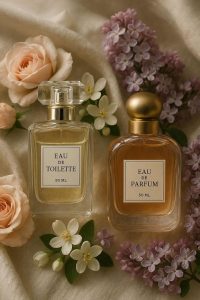
If you’ve stood at a fragrance counter comparing two versions of the same perfume — one labeled Eau de Parfum, the other Eau de Toilette — you’ve probably wondered whether the price difference is actually worth it. The short answer is that Eau de Parfum usually lasts longer, but “usually” is doing a lot of work in that sentence.
The real answer depends on concentration, the specific fragrance oils used, your skin, and even the weather. Here’s what’s actually happening inside the bottle, and how to pick the one that will genuinely last through your day.
The Short Answer: Eau de Parfum Usually Lasts Longer
Eau de Parfum (EDP) contains a higher concentration of fragrance oil than Eau de Toilette (EDT), which is why it typically lasts longer on skin — often 6 to 8 hours compared to 3 to 5 hours for EDT. More fragrance oil means more material for your skin to slowly release over time, which translates to a longer-lasting scent.
That said, “usually” isn’t “always.” Some EDTs are formulated with strong, tenacious ingredients that outlast a lightly built EDP. Concentration is a strong predictor of longevity, but it isn’t the only factor.
What Actually Separates EDP From EDT
The difference between the two comes down to how much pure fragrance oil (sometimes called “juice” or “concentrate”) is mixed with alcohol and water.
- Eau de Toilette (EDT): Lighter, typically around 5–15% fragrance oil
- Eau de Parfum (EDP): More concentrated, typically around 15–20% fragrance oil
A higher percentage of oil means the scent is more noticeable when first applied, evolves more slowly through its notes, and takes longer to fully evaporate off the skin.
Worth noting: these percentage ranges are industry convention rather than a legal standard. EU Regulation 1223/2009, the main law governing cosmetic products sold in Europe, requires fragrance ingredients to be disclosed under “parfum” or “aroma” on the label and mandates individual labeling for specific allergenic compounds above set thresholds — but it doesn’t define what percentage makes something an “eau de parfum” versus an “eau de toilette.” Brands set those concentrations themselves, which is why longevity can vary even between two EDPs from different houses.
Fragrance Concentration Percentages Explained
Here’s the fuller hierarchy, from lightest to strongest, as generally used across the fragrance industry:
- Eau Fraîche / Body Mist: 1–3% fragrance oil
- Eau de Cologne (EDC): 2–6% fragrance oil
- Eau de Toilette (EDT): 5–15% fragrance oil
- Eau de Parfum (EDP): 15–20% fragrance oil
- Parfum / Extrait de Parfum: 20–40% fragrance oil
Notice the overlap between tiers. A well-formulated EDT at 15% can actually contain more fragrance oil than a lightly built EDP at 15%. The label tells you the category the brand chose to market it under — not a guaranteed percentage you can compare precisely across different brands.
Why Higher Concentration Doesn’t Always Mean Longer-Lasting
Concentration is only part of the story. Longevity also depends on:
- The ingredients themselves — heavy, resinous notes like amber, oud, musk, and vanilla naturally cling to skin longer than light citrus or aquatic notes, regardless of overall concentration
- Molecular weight of the fragrance compounds — heavier molecules evaporate more slowly, which is why base-note-heavy fragrances often outlast top-note-driven ones
- How the formula is built — a skilled perfumer can make a 12% EDT outlast a poorly balanced 18% EDP
This is why comparing two different fragrances purely by their EDT/EDP label can be misleading. The concentration tells you the potential intensity, not a guaranteed outcome.
How Skin Type and Body Chemistry Change the Outcome
The same bottle can behave completely differently on two people, which is part of why fragrance longevity questions don’t have a single universal answer.
- Dry skin tends to hold fragrance less effectively than oily skin, since natural oils help “grip” fragrance molecules and slow evaporation
- Body temperature affects how quickly fragrance diffuses — warmer skin releases scent faster, which can mean stronger initial projection but sometimes shorter overall longevity
- Hydration matters too — moisturized skin generally holds fragrance longer than dry skin, which is why applying an unscented lotion before perfume is a common longevity trick
- Climate and humidity play a role, especially relevant if you’re in a hot, humid environment where fragrance evaporates faster regardless of concentration
Longevity vs Sillage vs Projection
These terms often get confused, but they measure different things:
- Longevity — how long you personally can still smell the fragrance on your skin
- Projection — how far the scent reaches from your body without anyone leaning in
- Sillage — the trail of scent left behind as you move through a space
An EDP can have strong longevity but modest projection, while some EDTs project surprisingly far despite fading faster. If your main concern is “will people still notice it hours later,” you’re really asking about projection and sillage, not just longevity.
When Eau de Toilette Is Actually the Better Choice
Longer-lasting isn’t automatically better. EDT has real advantages in specific situations:
- Office or shared spaces, where a lighter, less persistent scent is more considerate
- Hot climates, where heat amplifies fragrance intensity and a lighter concentration prevents the scent from becoming overwhelming
- Layering fragrances, since EDT gives you more control without overwhelming a combined scent profile
- Daily, casual wear, where reapplying once or twice during the day isn’t an inconvenience
- Sensitive skin, since lower alcohol and fragrance oil concentrations can be gentler for some people
How to Make Any Perfume Last Longer
Whether you’re wearing EDT or EDP, a few habits noticeably extend how long a fragrance lasts:
- Apply to pulse points — wrists, neck, and behind the ears, where body heat helps the scent develop
- Moisturize skin before applying — hydrated skin holds fragrance better than dry skin
- Avoid rubbing wrists together after spraying, which can break down top notes prematurely
- Store bottles away from heat and sunlight, since both degrade fragrance oils over time
- Layer with a matching scented body product, such as a lotion or oil in the same fragrance family, to build a longer-lasting base
Is the Extra Cost of Eau de Parfum Worth It?
EDP is almost always more expensive than the equivalent EDT, largely because of the higher concentration of fragrance oil, which is the costliest ingredient in the bottle. Whether that’s worth it depends on how you plan to wear it.
If you want a fragrance to carry you from morning meetings into an evening out without reapplying, EDP is usually the better investment. If you prefer a lighter presence, wear fragrance mainly in warm weather, or like switching scents throughout the day, EDT can be the more practical and cost-effective option — without meaningfully sacrificing the experience.
If you’re deciding between the two for a specific fragrance, browsing the available concentrations in a well-stocked shop and testing both side by side is the most reliable way to know which one suits you, since longevity really does vary by nose and skin.
Summary
Eau de Parfum generally lasts longer than Eau de Toilette because it contains a higher percentage of fragrance oil, but concentration alone doesn’t guarantee performance. Ingredient choice, skin type, climate, and application habits all shape how long a fragrance actually lasts on you. The better question isn’t just “which lasts longer” — it’s “which fits how and where you plan to wear it.”
Frequently Asked Questions
1. Does Eau de Parfum always last longer than Eau de Toilette?
Usually, yes, because it contains a higher concentration of fragrance oil. However, a well-formulated EDT with tenacious ingredients can sometimes outlast a lightly built EDP, so it’s not an absolute rule.
2. How many hours does Eau de Parfum last compared to Eau de Toilette?
Eau de Parfum typically lasts 6 to 8 hours, while Eau de Toilette generally lasts 3 to 5 hours. Actual longevity varies based on skin type, climate, and the specific fragrance formula.
3. Is Eau de Parfum stronger than Eau de Toilette?
Yes, Eau de Parfum generally has a higher fragrance oil concentration, making it smell more intense, especially right after application.
4. Why is Eau de Parfum more expensive than Eau de Toilette?
The higher concentration of fragrance oil in Eau de Parfum makes it more costly to produce, since fragrance oil is the most expensive component in a perfume formula.
5. Can I use Eau de Toilette every day instead of Eau de Parfum?
Yes, Eau de Toilette is well suited to daily wear, especially in warm climates or shared spaces where a lighter scent is preferable.
6. Does skin type affect how long perfume lasts?
Yes. Oily or well-moisturized skin tends to hold fragrance longer than dry skin, since natural oils help slow the evaporation of fragrance molecules.
7. What lasts longer, EDP or Parfum/Extrait?
Parfum (Extrait de Parfum) generally lasts the longest of all concentrations, since it typically contains 20–40% fragrance oil, more than either EDP or EDT.
Find the Right Concentration for You
Not sure whether Eau de Parfum or Eau de Toilette suits your lifestyle better? Explore Elizabeth Perfumery’s shop for a wide range of original fragrances across every concentration, with over 200 brands available and nationwide delivery across Nigeria. Reach out to our team for a personal recommendation based on how and where you plan to wear it.
